


AI Integration
& Digital Transformation
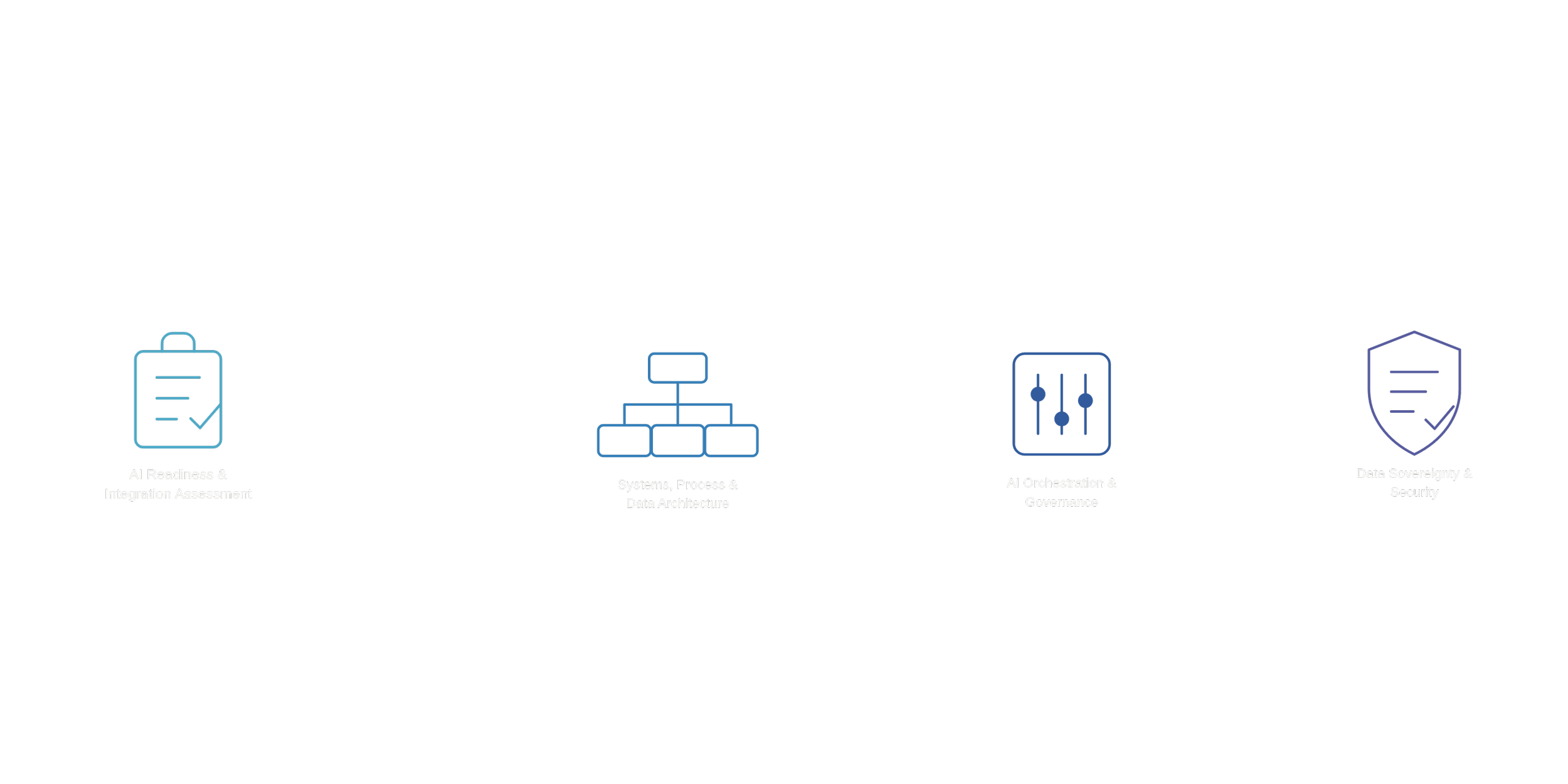
AI Readiness & Integration Assessment · Systems, Process & Data Architecture · AI Orchestration & Governance · Data Sovereignty & Security
New tools. Old architecture. Something has to give.
The proverb about new wine and old wineskins has rarely felt more apt. Its point was never that the wine or the vessel were flawed — it was a matter of nature: new wine expands, and a rigid, aging skin cannot stretch to hold something built to grow. Most organizations, like most software providers, are approaching AI the same way — pouring extraordinary, expansive new capability into infrastructure that was never designed to expand with it.
Schedule a conversationMost AI initiatives are evaluated by the tool alone: which LLM, which solution, which vendor. Rarely is that evaluation held up against what actually needs to shift, be remolded, or entirely rethought within the organization to make the technology work — its leadership, its data provenance, its decision-making structures, its roles and responsibilities, its process design. Real efficacy and growth come from aligning these deliberately with the new technology, not from adopting it in isolation. That alignment — or the absence of it — is almost always where the real failure occurs, long before the technology itself is ever at fault.
Two disciplines. One question, asked from either direction.
Real AI integration and non-traditional change management are not two separate initiatives running in parallel — they are the same work, viewed from two angles at once, and treating them as separate is precisely how expensive AI initiatives quietly under-deliver.
An AI tool that summarizes member risk for a credit union means nothing if the loan officer reading it has no actual authority to act on that judgment without three additional sign-offs.
A citizen-facing chatbot is only as good as the escalation pathway behind it — the actual humans, roles, and response times once a question exceeds what the bot can answer.
A predictive-maintenance model is worthless if the decision to act on its alert still has to travel up and down four layers of approval before a technician is dispatched.
In each case, the technology performed exactly as designed. What determined success or failure was the organizational architecture around it. This is why we treat AI readiness and organizational transformation as one discipline rather than two adjacent services. Getting the decision rights, roles, and process design right isn't a prerequisite to unlocking AI's value — it is how that value gets unlocked.
None of this transformation is an end in itself.
Its purpose is what becomes possible for the people an organization exists to serve — the credit union member seeking a faster, more transparent loan decision; the citizen who needs one government office, not four, to resolve a single request; the guest whose issue is resolved by the person in front of them, not escalated three times before someone has the authority to help.
Change management has always been human work — reading a room, building trust, knowing when a team is genuinely ready to move. Digital tools, done well, don't replace that work; they clear space for it.

In a region built from small, often young nations, sovereignty has never been abstract.
Every AI deployment carries a quieter question beneath the obvious one: not just what can this technology do, but where does our data actually live, who can access it, and under whose laws?
For institutions handling sensitive financial, health, or citizen data, that question deserves a real answer, not a vendor's reassurance. That increasingly means favoring solutions that support air-gapped, on-premise, or regionally hosted deployment, and insisting on real guardrails that keep personally identifiable and protected health information from quietly leaking into training pipelines or data centers an organization never chose and cannot audit.
Members, patients, and citizens are increasingly going to ask where their data lives and how it's used — and the institutions able to answer with genuine transparency, rather than a privacy policy no one reads, will be the ones that earn and keep their trust.
Orchestration & Governance
In the frenzy around AI, most organizations focus on the visible layer — a chatbot bolted onto a website — and miss the far bigger challenge underneath: bringing coherence to a decade's worth of disparate applications and databases that were never built to talk to each other. Most organizations don't have one AI problem. They have a dozen disconnected ones.
Unified over scattered
Genuine orchestration across systems, not another isolated tool solving one narrow problem in a vacuum.
Verification over assumption
Knowing how confident an AI-generated answer actually is, not simply trusting that it sounds right.
Governance built in, not bolted on
Compliance and oversight designed into the architecture from the outset, not patched in afterward.
Model-agnostic by design
No institution should be permanently locked to one model or provider — for resilience, and for economics.
We advise organizations on selecting and implementing platforms built around these principles, including hands-on partnership with a leading enterprise AI orchestration and governance platform serving regulated and public-sector clients across the region.
Most conversations about AI ethics treat it as something to write down. In practice, responsible AI is something an organization has to be capable of, in the same way it has to be capable of good governance or sound leadership. That capability shows up as:
Human judgment retained at the point of consequence — AI supports a decision; a person remains accountable for it.
Transparency the people affected can actually understand — a plain answer to "how did this decide about me."
Oversight structures that scale with stakes — the higher the consequence, the more human review it requires, not less.
Equity examined deliberately — a system trained on the past can quietly encode its blind spots into the future.
These aren't abstractions. They're organizational design choices, and getting them right is inseparable from the leadership and culture work we've always done.
For more than two decades, this practice has focused on the coherence between organizational and human systems and the tools that streamline and systemize them — long before "digital transformation" became a category of its own. That focus hasn't shifted with the arrival of AI; it has simply extended to include it. Levantto works with a team of experts across the region on both sides of this practice — advisory and change management, and technical specialists in AI and digital architecture — and is the Caribbean and Latin American regional advisory partner for an enterprise AI orchestration and governance platform. What's distinct about how we work is that we've never treated these two sides as separate disciplines requiring separate teams. Two decades of practice have made one thing clear: organizational transformation and technological transformation have to move together, or neither one holds. That same commitment extends forward, through Levantto's AI Innovation and Internship programs, training emerging regional talent in applied, responsible AI practice.
The right wineskin doesn't limit what the wine can become. It's the only thing that lets it.
If your organization is bringing in new tools faster than it's rebuilding what holds them, that's the conversation worth having.
Schedule a conversation